Holy mole! In praise of authentic Mexican (recipe and video)
Originally filed at roneade.com
Authentic Mexican mole simply means poultry will never be the same again.
Publication note. The reporting dates from 2014 to 2016. Ron Eade died in August 2015; nothing on this site is new writing in his voice. Restaurants, prices and staffing reflect the date shown above.
Why mole is worth the trouble
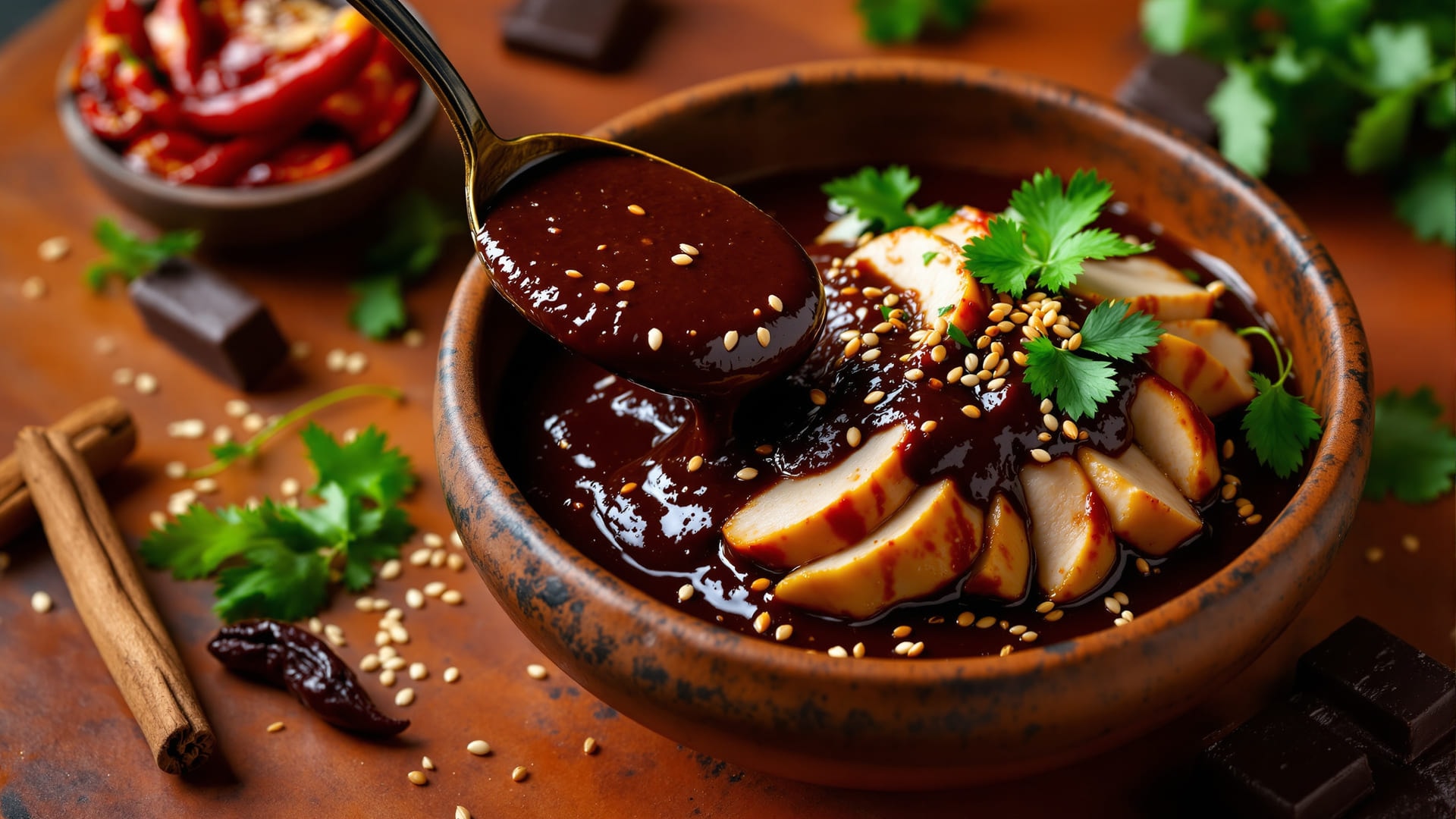
Among the tasty treasures that come out of a home kitchen, Eade wrote, few are as wondrous and rewarding as mole — the rich, nuanced chilli sauce particularly associated with the Mexican states of Puebla, Oaxaca and Tlaxcala.
You can buy a jar from the Mexican aisle of a well-stocked supermarket, he conceded, but it does not come close to a carefully made, long-simmered sauce built from a variety of chilli peppers, stock, peanuts, fat, sesame seeds and Mexican chocolate — and a great deal of time to marry the ingredients.
The origin story
One version of the origin, recounted in the piece, places it at the Convent of Santa Rosa in Puebla, where nuns were told an archbishop was coming and, being poor, had very little to cook with. They gathered what they had — chilli peppers, spices, stale bread, nuts and chocolate — and served the result on turkey. It was an immediate success. There are other versions, Eade noted, but the point of all of them is the same: this is not a dish built from expensive ingredients.
The teacher
His instructor was Maria Amalia Garza, a self-taught cook running a small cooking school in Orléans that offered classes in Mexican, Thai, Moroccan and Cuban cooking among others.
"I think mole is the most iconic sauce in Mexican cuisine," she said. "People who know and love food know about mole. It's a fusion because some ingredients are not native to Mexico, like sesame seeds and coriander, for example. And while lard came with the Spanish to Mexico, before the Spanish there were no domesticated pigs in America. So the Spanish introduced pigs, and the culinary fusion began. And with the appearance of lard, then frying began."
Technique
Garza's version comes together in a few hours rather than days. "Mole represents a fusion of ancient toasting and roasting techniques, with lard added for richness and depth," she said. "It's always best to simmer it with fat and chicken stock for a long time, but today we're going to make it rather quickly. But it really should be a labour of love and patience."
The recipe calls for no fewer than four different dried chillies, available from Latin American food shops. "It's important to toast the chiles to bring out the essential oils and flavours, just as you would toast spices," Garza said. "We're also toasting and roasting the seeds, nuts and spices in this recipe — that's one reason why it takes such a long time. A great mole can take a couple of days to prepare, but we're going to rush it along a bit today." As an alternative to toasting, she noted, the home cook can fry the ingredients in lard to develop still more flavour.
Points of comparison
Eade had eaten a good deal of mole over the years and named two standards he measured against. The first was a version made by the executive chef and co-owner of an acclaimed Toronto restaurant, who had cooked for the Mexican embassy in Ottawa in 2010.
The second is the detail people remember from this piece. Ottawa chef René Rodriguez, of a ByWard Market restaurant, made a multi-layered mole with lamb stock, chilli peppers, chocolate and many spices which he simmered intermittently for sixty days — two months — to reach the depth of flavour he wanted.
Reading it now
Two things date this piece pleasantly. One is the confidence that a serious Mexican sauce was still a discovery worth a long post in an Ottawa food blog. The other is the assumption that finding four kinds of dried chilli required a special trip.
What has not dated is the technical content: toasting to release essential oils, the role of fat, the difference a long simmer makes to how the elements combine. Readers wanting the botanical and nutritional background to the chillies, seeds and nuts involved will find the ingredient-level detail in the Canadian Food Inspection Agency materials on imported produce and labelling.
Eade returned to Mexican cooking at a December benefit dinner, where a chef contributed a tuna taco tartare; and the same interest in slow, technique-heavy craft runs through the eighty-day dry-ageing programme documented at an Eastern Ontario charcuterie plant.